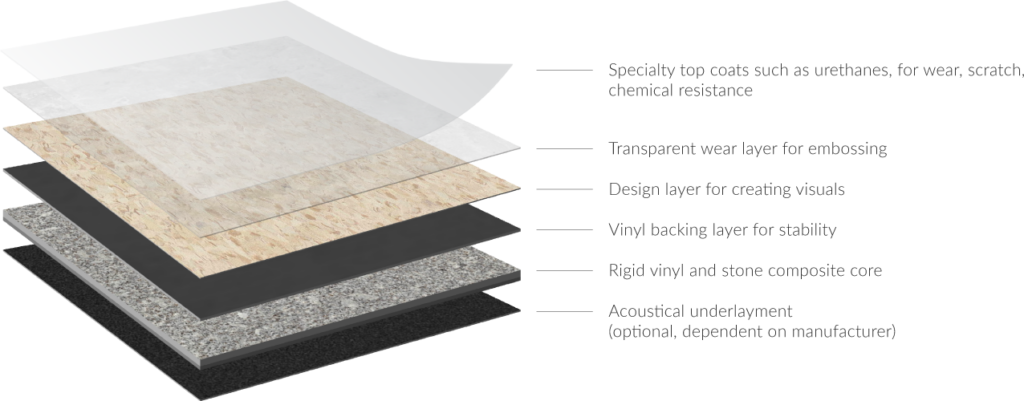
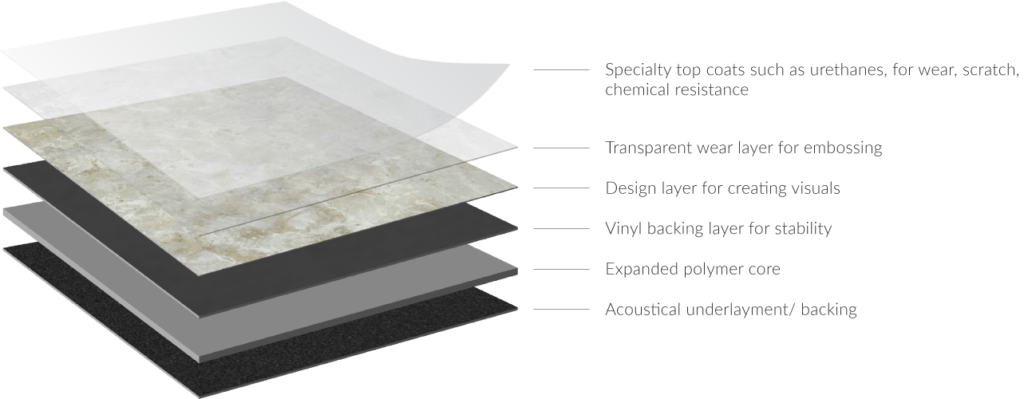
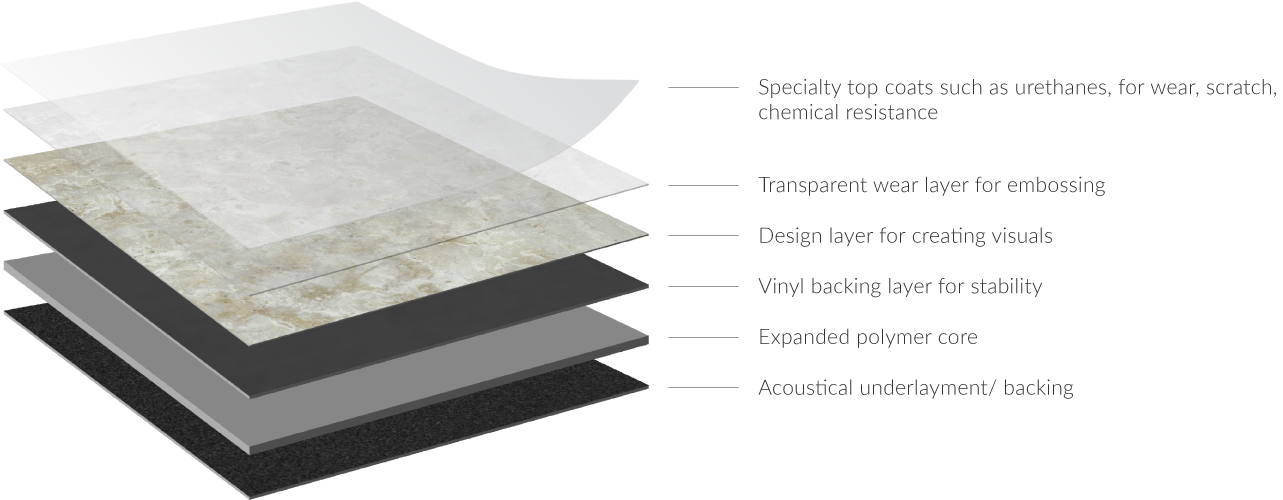
A newer class of LVT products referred to as Rigid Core or Multilayer flooring has emerged which adds features and benefits to the many design and performance benefits of flexible vinyl LVT products. Rigid Core/Multilayer flooring is defined as modular flooring with a rigid polymeric core, a decorative top surface and an optional soft underlayment pre-attached to the bottom of the product. Rigid Core products are produced in many realistic visuals and in tile and plank formats. Look for the ASSURE® Certified badge for smart, durable and responsibly made Rigid Core flooring.
There are two Rigid Core product constructions, Expanded Polymer Core (WPC) and Solid Polymer Core (SPC).
WPC features an expanded polymer core that is light in weight and provides underfoot comfort with good acoustical qualities. WPC's thicker construction provides the ability for creating realistic textures. WPC is most often used in residential applications although these products generally include a light to medium traffic commercial warranty.
SPC is made with a solid polymer core, which makes it denser, providing additional benefits due to its hardness. SPC products have greater resistance to indentations, improved dimensional stability, and favorable temperature stability.
Both WPC and SPC constructions feature rigid cores that have water resistant capabilities.
A pre-attached cork or other acoustical underlayment is often applied to provide added warmth and sound absorption as well as reduced subfloor preparation.
Both WPC and SPC are offered in a variety of wear layers. The application and related wear layer, and the budget are determining factors for choosing WPC or SPC.
Manufacturers of each provide guidance on residential and commercial usage for the various SKUs.
Construction
How it’s built
SPC (Solid Polymer Core)
SPC (Solid Polymer Core)
WPC (Expanded Polymer Core)
WPC (Expanded Polymer Core)
Advantages
Why choose Rigid Core
The key benefits that make Rigid Core a trusted choice across commercial and institutional environments.
Known for durability
Easier to maintain
Many water resistant options
Lower installation costs
Unique locking systems enable installation as a floating floor in many applications
Robust design universe
Broad array of price points
Added cushioning and sound absorption with attached underlayment
Modular format provides options if tile replacement is necessary.
Can sometimes install over hard surfaces
Installation
How it’s installed
Many Rigid Core products can be installed as floating floors using click-lock systems. Because of their rigidity, they can often tolerate minor substrate variation better than flexible products, but manufacturer requirements for flatness, expansion space, moisture, and underlayment should still govern the installation. Always follow the manufacturer's installation instructions.